 |
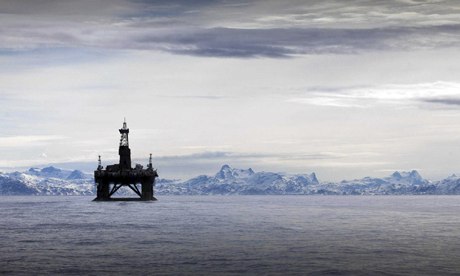
| An oil rig off Greenland's coast in the Arctic waters. Photograph: Greenpeace |
A serious oil spill in the Arctic is a "dead cert" if drilling goes ahead, with potentially devastating consequences for the pristine region, according to a leading marine scientist who played a key role in analysis of BP's Deepwater Horizon oil spill. The warning came as Russia filed court orders this week to have Greenpeace activists and journalists kept in prison for a further three months in prison before their trial over a protest at Arctic oil dirlling.
Concerns about the potentially dire consequences of drilling for oil in the region have intensified as the Russian government and others have begun exploration under the Arctic seas. In such a cold region, any spill would be much more troublesome, because the oil would not naturally disperse as it does in warmer waters, and because of the difficulty of mounting a clean-up operation in hostile weather conditions.
The "Arctic 30" – comprising 28 activists and two journalists – were arrested when Greenpeace's Arctic Sunrise vessel was boarded by Russian coastguards in September and are facing lengthy jail terms if they are convicted. They have been kept in harsh conditions in freezing cold jail cells with poor food, and are being moved 800 miles from Murmansk to St Petersburg.
Simon Boxall, an oil spill expert from the University of Southampton, told the Guardian exploring the region was inherently dangerous: "It is inevitable you will get a spill – a dead cert. I would expect to see a major spill in the not too distant future. I would be astonished if you did not see a major spill from this."
The conditions in the Arctic would vastly compound the problem, he said. "It's a completely different environment. In temperate climes, oil disperses quickly. Bacteria help [to digest the oil]. In the Arctic the oil does not break down in this way – it can take decades before it breaks down. Nature will not help us."
Concerns about the potentially dire consequences of drilling for oil in the region have intensified as the Russian government and others have begun exploration under the Arctic seas. In such a cold region, any spill would be much more troublesome, because the oil would not naturally disperse as it does in warmer waters, and because of the difficulty of mounting a clean-up operation in hostile weather conditions.
The "Arctic 30" – comprising 28 activists and two journalists – were arrested when Greenpeace's Arctic Sunrise vessel was boarded by Russian coastguards in September and are facing lengthy jail terms if they are convicted. They have been kept in harsh conditions in freezing cold jail cells with poor food, and are being moved 800 miles from Murmansk to St Petersburg.
Simon Boxall, an oil spill expert from the University of Southampton, told the Guardian exploring the region was inherently dangerous: "It is inevitable you will get a spill – a dead cert. I would expect to see a major spill in the not too distant future. I would be astonished if you did not see a major spill from this."
The conditions in the Arctic would vastly compound the problem, he said. "It's a completely different environment. In temperate climes, oil disperses quickly. Bacteria help [to digest the oil]. In the Arctic the oil does not break down in this way – it can take decades before it breaks down. Nature will not help us."
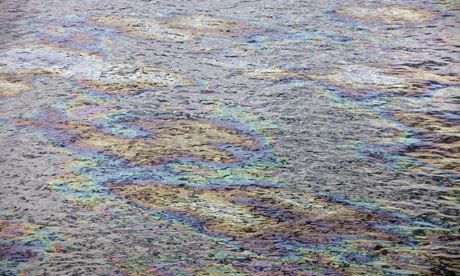 |
| The surface of the Gulf of Mexico glistens with color as light reflects off the oil sheen at the site of the Deepwater Horizon oil spill in the Gulf of Mexico. Photograph: Dave Martin/AP |
During those decades, any spilled oil would be a serious hazard to marine life.
No industry is perfect, Boxall said, but the oil industry has behaved poorly in the past. "There are lots of failsafes on planes, but accidents still happen. At times, this is an irresponsible industry. Corners are cut, money is saved in small ways. Then it can go wrong and end up costing a huge amount of money, like in the Gulf of Mexico."
He added: "Different countries have different levels of health and safety. Russia does not have an enviable record on this."
Even without a spill, exploring the region could disrupt the Arctic environment, warned Jonathan Bamber of the University of Bristol. "You get an increase in shipping, and ships release their ballast water which contains species from other areas. So you could get the introduction to the Arctic of entirely foreign species and we don't know the impact of that. The Arctic ocean is very enclosed, virtually landlocked, so this could have very big consequences and affect the whole food chain."
No industry is perfect, Boxall said, but the oil industry has behaved poorly in the past. "There are lots of failsafes on planes, but accidents still happen. At times, this is an irresponsible industry. Corners are cut, money is saved in small ways. Then it can go wrong and end up costing a huge amount of money, like in the Gulf of Mexico."
He added: "Different countries have different levels of health and safety. Russia does not have an enviable record on this."
Even without a spill, exploring the region could disrupt the Arctic environment, warned Jonathan Bamber of the University of Bristol. "You get an increase in shipping, and ships release their ballast water which contains species from other areas. So you could get the introduction to the Arctic of entirely foreign species and we don't know the impact of that. The Arctic ocean is very enclosed, virtually landlocked, so this could have very big consequences and affect the whole food chain."
 |
| Arctic map showing location of Prirazlomnaya rig and where Greenpeace boat was seized |
Greenpeace pointed out that the Arctic is the habitat for "a diverse range of unique wildlife", including 17 species of whale – such as the endangered narwhal, 90% of the remaining population of which lives in Baffin Bay – as well as polar bears, Arctic foxes, seals, hundreds of species of seabirds and millions of migrating birds. There are also 4m people who live in the Arctic, descendants of indigenous communities who have lived there for thousands of years. "The impact of a spill on these communities and already vulnerable animal species would be devastating and long-lasting," the group said.
Three Russian nationals among the Arctic 30 – Yekaterina Zaspa, Denis Sinyakov and Andrey Allakhverdov – were released on bail on Monday.
Gazprom Neft Shelf, the branch of the Russian state energy behemoth that runs the Prirazlomnaya platform where Greenpeace staged its protest in September, said that after multiple delays it planned to start drilling in December, and currently the rig is working in test mode. Next year, the plan is to produce 600,000 tonnes of oil, and the company says output will peak in 2021 when it will be working at maximum capacity and producing 6m tonnes per year.
Gennady Lubin, executive director of Gazprom Neft Shelf, declined to speak to the Guardian, but in a recent interview with an oil and gas periodical rubbished the claims of environmentalists that the rig's location makes it a uniquely dangerous operation. He said there were two icebreakers moored adjacent to the rig which are on permanent standby to deal with any emergency situations, and additional equipment available in the town of Varandey, about 40 miles from the platform. "Of course, in theory it is possible to contemplate any script based on the assumption that if you don't do that, environmental safety might be in danger," said Lyubin. "But that kind of thinking is absurd."
He also dismissed concerns about the durability of the rig itself. The top part of the rig was taken from a decommissioned North Sea oil rig built in 1984, which has led to further speculation about the reliability of Prirazlomnaya, but the Russians claim that the critics are again wrong.
Lyubin says Prirazlomnaya is a "new facility" that was "built to operate in the specific weather conditions of the Pechora Sea", and that only small parts of the Hutton rig were used in the structure. "The specially designed caisson part has allowed us to create a facility that successfully resists the Arctic climate, waves and ice, to protect all equipment and to ensure safe operation."
Lyubin said that Prirazlomnaya was inherently more secure than, for example, the Deepwater Horizon oil rig in the Gulf of Mexico. "The wells there are drilled from a floating platform, which is at hundreds of meters distance from the seabed," said Lyubin. "But here, the sea depth in the field area is 19-20 meters, so the Prirazlomnaya is installed directly on the seabed."
"The Arctic has been important for us for centuries," said Roman Khatsevich of the Murmansk Institute of Economics. "It's not just economics. Our country is a northern country, and the Arctic is one of the foundation blocks of our statehood. In the 1990s a lot of Arctic financing was stopped due to the economic and political collapse, but since 2000 it has been a priority again."
For now, there is a big question about how economically viable oil extraction in the taxing conditions will be, but Russia is pushing ahead with a number of major programmes to improve infrastructure in the region with an eye on both oil extraction and on developing the Northern Sea route through the Russian Arctic, as an alternative shipping lane from Europe to Asia.
"Especially with the worsening situation in the Middle East, the Arctic could become more and more important as a shipping route. In an ideal world, the Arctic can be a forum for international co-operation rather than conflict," said Khatsevich.
Just last week, Russian oil giant Rosneft signed a deal with Korean shipbuilding company Daewoo that should lead to the establishment of a major new shipbuilding cluster in Russia's far east, that would build icebreakers and marine equipment for offshore energy projects.
via : the guardian
Three Russian nationals among the Arctic 30 – Yekaterina Zaspa, Denis Sinyakov and Andrey Allakhverdov – were released on bail on Monday.
Gazprom Neft Shelf, the branch of the Russian state energy behemoth that runs the Prirazlomnaya platform where Greenpeace staged its protest in September, said that after multiple delays it planned to start drilling in December, and currently the rig is working in test mode. Next year, the plan is to produce 600,000 tonnes of oil, and the company says output will peak in 2021 when it will be working at maximum capacity and producing 6m tonnes per year.
Gennady Lubin, executive director of Gazprom Neft Shelf, declined to speak to the Guardian, but in a recent interview with an oil and gas periodical rubbished the claims of environmentalists that the rig's location makes it a uniquely dangerous operation. He said there were two icebreakers moored adjacent to the rig which are on permanent standby to deal with any emergency situations, and additional equipment available in the town of Varandey, about 40 miles from the platform. "Of course, in theory it is possible to contemplate any script based on the assumption that if you don't do that, environmental safety might be in danger," said Lyubin. "But that kind of thinking is absurd."
He also dismissed concerns about the durability of the rig itself. The top part of the rig was taken from a decommissioned North Sea oil rig built in 1984, which has led to further speculation about the reliability of Prirazlomnaya, but the Russians claim that the critics are again wrong.
Lyubin says Prirazlomnaya is a "new facility" that was "built to operate in the specific weather conditions of the Pechora Sea", and that only small parts of the Hutton rig were used in the structure. "The specially designed caisson part has allowed us to create a facility that successfully resists the Arctic climate, waves and ice, to protect all equipment and to ensure safe operation."
Lyubin said that Prirazlomnaya was inherently more secure than, for example, the Deepwater Horizon oil rig in the Gulf of Mexico. "The wells there are drilled from a floating platform, which is at hundreds of meters distance from the seabed," said Lyubin. "But here, the sea depth in the field area is 19-20 meters, so the Prirazlomnaya is installed directly on the seabed."
"The Arctic has been important for us for centuries," said Roman Khatsevich of the Murmansk Institute of Economics. "It's not just economics. Our country is a northern country, and the Arctic is one of the foundation blocks of our statehood. In the 1990s a lot of Arctic financing was stopped due to the economic and political collapse, but since 2000 it has been a priority again."
For now, there is a big question about how economically viable oil extraction in the taxing conditions will be, but Russia is pushing ahead with a number of major programmes to improve infrastructure in the region with an eye on both oil extraction and on developing the Northern Sea route through the Russian Arctic, as an alternative shipping lane from Europe to Asia.
"Especially with the worsening situation in the Middle East, the Arctic could become more and more important as a shipping route. In an ideal world, the Arctic can be a forum for international co-operation rather than conflict," said Khatsevich.
Just last week, Russian oil giant Rosneft signed a deal with Korean shipbuilding company Daewoo that should lead to the establishment of a major new shipbuilding cluster in Russia's far east, that would build icebreakers and marine equipment for offshore energy projects.
via : the guardian


