Showing posts with label teens. Show all posts

Wednesday, 29 January 2014

Watermelon Health Benefits


  • Rich in electrolytes and water content, melons are nature’s gift to beat tropical summer thirst.
  • Watermelons are very low in calories (just 30 calories per 100 g) and fats yet very rich source of numerous health promoting phyto-nutrients and anti-oxidants that are essential for optimum health.
  • Watermelon is an excellent source of Vitamin-A, which is a powerful natural anti-oxidant. 100 g fresh fruit provides 569 mg or 19% of daily-required levels of this vitamin. It is essential for vision and immunity. Vitamin-A is also required for maintaining healthy mucus membranes and skin. Consumption of natural fruits rich in vitamin-A is known to protect from lung and oral cavity cancers.
  • It is also rich in anti-oxidant flavonoids like lycopene, beta-carotene, lutein, zeaxanthin and cryptoxanthin. These antioxidants are found to offer protection against colon, prostate, breast, endometrial, lung, and pancreatic cancers. Phyto-chemicals present in watermelon like lycopene and carotenoids have the ability to help protect cells and other structures in the body from oxygen-free radicals.
  • Watermelon is an excellent source of carotenoid pigment, lycopene and indeed, superior to raw red tomato. 100 g of fresh melon provides 4532 µg lycopene, whereas only 2573 µg in tomatoes. Studies suggest that lycopene offer certain protection to skin from harmful UV rays.
  • Watermelon fruit is a good source of potassium; Potassium is an important component of cell and body fluids that helps controlling heart rate and blood pressure; It thus offers protection against stroke and coronary heart diseases.

Tuesday, 19 November 2013

Turnip Rock, Michigan, USA


Arctic oil spill is certain if drilling goes ahead, says top scientist

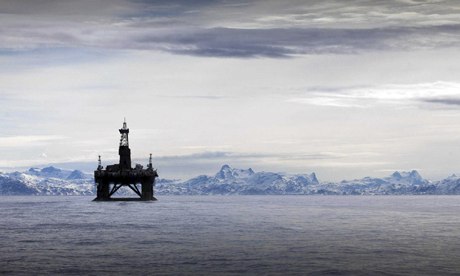
Arctic oil spill pollution risks : Cairn Energy Leiv Eiriksson oil rig
An oil rig off Greenland's coast in the Arctic waters. Photograph: Greenpeace

A serious oil spill in the Arctic is a "dead cert" if drilling goes ahead, with potentially devastating consequences for the pristine region, according to a leading marine scientist who played a key role in analysis of BP's Deepwater Horizon oil spill. The warning came as Russia filed court orders this week to have Greenpeace activists and journalists kept in prison for a further three months in prison before their trial over a protest at Arctic oil dirlling.
Concerns about the potentially dire consequences of drilling for oil in the region have intensified as the Russian government and others have begun exploration under the Arctic seas. In such a cold region, any spill would be much more troublesome, because the oil would not naturally disperse as it does in warmer waters, and because of the difficulty of mounting a clean-up operation in hostile weather conditions.
The "Arctic 30" – comprising 28 activists and two journalists – were arrested when Greenpeace's Arctic Sunrise vessel was boarded by Russian coastguards in September and are facing lengthy jail terms if they are convicted. They have been kept in harsh conditions in freezing cold jail cells with poor food, and are being moved 800 miles from Murmansk to St Petersburg.
Simon Boxall, an oil spill expert from the University of Southampton, told the Guardian exploring the region was inherently dangerous: "It is inevitable you will get a spill – a dead cert. I would expect to see a major spill in the not too distant future. I would be astonished if you did not see a major spill from this."
The conditions in the Arctic would vastly compound the problem, he said. "It's a completely different environment. In temperate climes, oil disperses quickly. Bacteria help [to digest the oil]. In the Arctic the oil does not break down in this way – it can take decades before it breaks down. Nature will not help us."

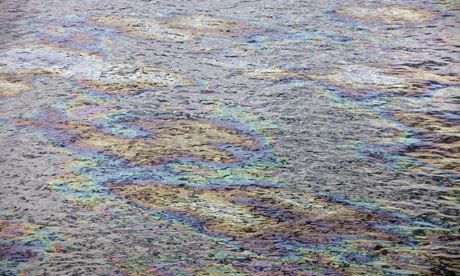
Arctic oil spill pollution risks : Deepwater Horizon oil spill in the Gulf of Mexico
The surface of the Gulf of Mexico glistens with color as light reflects off the oil sheen at the site of the Deepwater Horizon oil spill in the Gulf of Mexico. Photograph: Dave Martin/AP


During those decades, any spilled oil would be a serious hazard to marine life.
No industry is perfect, Boxall said, but the oil industry has behaved poorly in the past. "There are lots of failsafes on planes, but accidents still happen. At times, this is an irresponsible industry. Corners are cut, money is saved in small ways. Then it can go wrong and end up costing a huge amount of money, like in the Gulf of Mexico."
He added: "Different countries have different levels of health and safety. Russia does not have an enviable record on this."
Even without a spill, exploring the region could disrupt the Arctic environment, warned Jonathan Bamber of the University of Bristol. "You get an increase in shipping, and ships release their ballast water which contains species from other areas. So you could get the introduction to the Arctic of entirely foreign species and we don't know the impact of that. The Arctic ocean is very enclosed, virtually landlocked, so this could have very big consequences and affect the whole food chain."

Arctic map showing location of Prirazlomnaya rig and where Greenpeace boat was seized
Greenpeace pointed out that the Arctic is the habitat for "a diverse range of unique wildlife", including 17 species of whale – such as the endangered narwhal, 90% of the remaining population of which lives in Baffin Bay – as well as polar bears, Arctic foxes, seals, hundreds of species of seabirds and millions of migrating birds. There are also 4m people who live in the Arctic, descendants of indigenous communities who have lived there for thousands of years. "The impact of a spill on these communities and already vulnerable animal species would be devastating and long-lasting," the group said.
Three Russian nationals among the Arctic 30 – Yekaterina Zaspa, Denis Sinyakov and Andrey Allakhverdov – were released on bail on Monday.
Gazprom Neft Shelf, the branch of the Russian state energy behemoth that runs the Prirazlomnaya platform where Greenpeace staged its protest in September, said that after multiple delays it planned to start drilling in December, and currently the rig is working in test mode. Next year, the plan is to produce 600,000 tonnes of oil, and the company says output will peak in 2021 when it will be working at maximum capacity and producing 6m tonnes per year.
Gennady Lubin, executive director of Gazprom Neft Shelf, declined to speak to the Guardian, but in a recent interview with an oil and gas periodical rubbished the claims of environmentalists that the rig's location makes it a uniquely dangerous operation. He said there were two icebreakers moored adjacent to the rig which are on permanent standby to deal with any emergency situations, and additional equipment available in the town of Varandey, about 40 miles from the platform. "Of course, in theory it is possible to contemplate any script based on the assumption that if you don't do that, environmental safety might be in danger," said Lyubin. "But that kind of thinking is absurd."
He also dismissed concerns about the durability of the rig itself. The top part of the rig was taken from a decommissioned North Sea oil rig built in 1984, which has led to further speculation about the reliability of Prirazlomnaya, but the Russians claim that the critics are again wrong.
Lyubin says Prirazlomnaya is a "new facility" that was "built to operate in the specific weather conditions of the Pechora Sea", and that only small parts of the Hutton rig were used in the structure. "The specially designed caisson part has allowed us to create a facility that successfully resists the Arctic climate, waves and ice, to protect all equipment and to ensure safe operation."
Lyubin said that Prirazlomnaya was inherently more secure than, for example, the Deepwater Horizon oil rig in the Gulf of Mexico. "The wells there are drilled from a floating platform, which is at hundreds of meters distance from the seabed," said Lyubin. "But here, the sea depth in the field area is 19-20 meters, so the Prirazlomnaya is installed directly on the seabed."
"The Arctic has been important for us for centuries," said Roman Khatsevich of the Murmansk Institute of Economics. "It's not just economics. Our country is a northern country, and the Arctic is one of the foundation blocks of our statehood. In the 1990s a lot of Arctic financing was stopped due to the economic and political collapse, but since 2000 it has been a priority again."
For now, there is a big question about how economically viable oil extraction in the taxing conditions will be, but Russia is pushing ahead with a number of major programmes to improve infrastructure in the region with an eye on both oil extraction and on developing the Northern Sea route through the Russian Arctic, as an alternative shipping lane from Europe to Asia.
"Especially with the worsening situation in the Middle East, the Arctic could become more and more important as a shipping route. In an ideal world, the Arctic can be a forum for international co-operation rather than conflict," said Khatsevich.
Just last week, Russian oil giant Rosneft signed a deal with Korean shipbuilding company Daewoo that should lead to the establishment of a major new shipbuilding cluster in Russia's far east, that would build icebreakers and marine equipment for offshore energy projects.

via : the guardian 

Sunday, 17 November 2013

"Robobaby" gives teens an idea of what parenting is really like

There's a popular educational exercise in which teens are required to take care of a bag of flour for several days, as if it's a baby. The idea is that by having to lug that bag around with them everywhere they go, while keeping it from getting damaged, the kids will realize how much responsibility is involved in raising an infant. As any parent will tell you, however, there's a lot more to baby-raising than just safely lugging them around. That's why products like Realityworks' RealCare Baby were created.

We recently spotted the latest version of the interactive mannequin, RealCare Baby 3, at the International Robotics Exhibition in Tokyo. Although it's not the only device of its kind, it is one of the most recent to hit the market, and definitely among the most technologically-advanced.

The mannequin (or robot, or doll, or whatever you want to call it) is designed to be used in a training program for teens or other people, who either want to get ready for having their first child or need to be made aware of the sacrifices that would be involved in doing so. As such, it comes with a lesson plan that can be administered by someone such as a counselor.
The baby itself weighs about the same as a real infant of its size, and contains various sensors and other electronics. It will spontaneously start crying at any time of the day or night, and must be tended to by one of its "parents" within no more than two minutes – any longer, and their tardiness will be noted in an onboard data logger.

Once the parent gets to the baby, they must pick it up in a gentle manner, supporting its head as they do so. If they're rough with it, it will start crying louder, and the logger will once again make a note of their transgression. They then need to determine why it's crying – it could need changing (it comes with two sets of diapers), it could need feeding (it also comes with a bottle and breast-feeding device), it could need to be burped, or it could simply be fussing and need to be gently rocked.


Along with responding properly to its cries, parents can't just forget about the baby when it's quiet. If it's allowed to get too hot or too cold, if it's left too long in one item of clothing, or if it's kept in its optional car seat too long, parents will earn demerits. Additionally, they can't just pawn off its care on someone else. For the duration of the lesson, they're required to wear a tamperproof RF bracelet. A receiver in the baby recognizes the signal of that specific bracelet, and won't respond to the actions of anyone not wearing it.
When the lesson period is over, data is downloaded from the logger to a PC or Mac, to be assessed by the administrator with the parent. Should students need some specialized education, Realityworks also offers a Drug-affected Baby, a Fetal Alcohol Syndrome Baby, and a Shaken Baby.

Saturday, 16 November 2013

Video games can be good for kids

Don't feel guilty for stuffing Sonic in the Santa sack - video games can be good for your children's mental health.

In fact, according to the director of QUT's Games Research and Interaction Design Lab, Dr Daniel Johnson, playing video games as a family can help you build stronger relationships with your children.


Dr Johnson and his gaming research group at the Young and Well Cooperative Research Centre (CRC) combed through 200 papers and reports from around the world to find out when and how video games can have a positive effect on the wellbeing of young players.
They discovered that the types of video games a young person plays is less important for their wellbeing than how they play videogames - and who they play them with.
Their research challenges the belief that video games breed socially isolated, aggressive and lazy teenagers.

"Our research showed that playing video games can improve a young person's mood, help them reduce their stress levels, and promote feelings of competence and autonomy," said Dr Johnson, from QUT's Science and Engineering Faculty.

"Playing video games with others in particular increases a person's brain activity, improves their social wellbeing and helps them feel more connected with others.

"If you're trying to reach out to the teenager in your house, spending time with them playing a cooperative video game you both enjoy could be the bridge you're looking for - and you'll likely feel the same positive impacts on your wellbeing, too."

Dr Johnson cautioned that excessive or obsessive video game play and technology use was not good for mental health as this could lead to negative outcomes such as anxiety and insomnia.

But overall, his team's research found:
- moderate (non-excessive) levels of playing are associated with positive emotions and improved mood, improved emotion regulation and emotional stability and the reduction of emotional disturbances
- playing video games can be a healthy means of relaxation, stress reduction and socialising
- people who play video games in moderation have been shown to have significantly less depressed mood and higher self-esteem compared to those who don't play or who play excessively.

More than 95 per cent of Australian homes with children aged under 18 have one or more devices for playing video games.

"One of the most important things you can do as a parent is to ensure you and your child engage thoughtfully with what you are playing," Dr Johnson said.

"Look for games that encourage creativity and cooperation and that are age appropriate."
Dr Johnson will present the results of a range of studies conducted by the QUT Games Research Lab as well as the Young and Well CRC's findings at a Videogames and Wellbeing lecture at the University of Sydney on Tuesday 19 November.

His presentation will also explore: the genres, modes of play and experiences during play that influence wellbeing; the predictors of obsessive and harmonious passion for play; and the differences in brain activity associated with playing with humans versus Artificial intelligence (AI) controlled teammates.

"People talk a lot about technologies being good or bad for us - phones, social media, video games - but it's never that simplistic," said Associate Professor Rafael Calvo from the University of Sydney's School of Electrical and Information Engineering and host of the talk.
"Technologies impact our wellbeing in positive and negative ways, depending in part on how they're designed.

"The fact is, we need to start measuring and understanding this impact better so we can design future technology that actively promotes wellbeing and human potential."

Dr Johnson said his team's future research will in part focus on what constitutes a healthy or moderate amount of play for people at different ages and how best to leverage the wellbeing benefits of video games in a therapeutic setting.

Chocolate lovers rejoice: More chocolate means less body fat

In what may be the best news for chocoholics since scientists at the University of Cambridge found that higher chocolate consumption was associated with a significant reduction in cardiovascular disease, diabetes and stroke, researchers at the University of Granada are reporting that it's also associated with lower levels of total fat deposits – in the bodies of adolescents at least.

The researchers from the Faculty of Medicine and Faculty of Physical Activity and Sports Sciences at the University of Granada conducted a study comprising 1,458 European adolescents aged between 12 and 17 years old and found that not only did higher chocolate consumption not lead to an increase in fat deposits in the participants, but it was actually associated with lower levels of total fat – fat deposits all over the body and central-abdominal fat – regardless of physical activity and diet.

The study estimated total fat deposits through body mass index, waist circumference and body fat percentage, which was measured by skinfolds and bioelectrical impedance analysis. Lower levels of total and central fat deposits were witnessed in participants with higher chocolate intake, regardless of age, sex, sexual maturation, total energy intake, physical activity and intake of saturated fats, fruits, vegetables, tea and coffee.

The researchers suggest the results could be partly due to catechins, a type of flavonoid that chocolate is especially rich in that boasts multiple health benefits and influences cortisol production and insulin sensitivity in the body. “They have important antioxidant, antithrombotic, anti-inflammatory and antihypertensive effects and can help prevent ischemic heart disease," explains Magdalena Cuenca-García who was the principle author of the study.

“The most recent epidemiologic research focuses on studying the relation between specific foods – both for their calorie content and for their components – and the risk factors for developing chronic illnesses, including overweight and obesity,” the researchers say in their study.

But before you go out and gorge yourself on chocolate bars, the researchers warn that, as with most things, chocolate should be consumed in moderation.

“In moderate quantities, chocolate can be good for you, as our study has shown. But, undoubtedly, excessive consumption is prejudicial. As they say: you can have too much of a good thing."

The team's study is published in the journal Nutrition.

Source: University of Granada